
The Twelve-Month AI Rule
1. Executive summary
Most organisations now have an AI roadmap. Far fewer have one that pays for itself. Deloitte's 2025 survey of 1,854 executives found that most organisations take two to four years to achieve satisfactory return on a typical AI use case, against the seven to 12 months normally expected of technology investments. Only 6 per cent reported payback within a year [1]. IBM's 2025 study of 2,000 CEOs found that just 25 per cent of AI initiatives had delivered their expected return [2].
The technology is not the main problem. The way roadmaps are built and judged is. Costs are undercounted, benefits are reported as hours saved rather than dollars banked, and initiatives are ranked by what is technically exciting or what trims internal cost, rather than by what customers and citizens are experiencing.
Our view is simple. Every AI initiative should show full-cost payback within 12 months, and initiatives that remove a customer pain point that is damaging the brand should go ahead of those that only make internal work faster. A roadmap built this way funds itself as it goes. One that takes two years to build and seven to pay back is a bet that the technology, the market and the leadership team will all stand still. None of them will.
Key takeaways
- Count the full cost. Data preparation, integration, change, human oversight, usage-driven running costs and the cost of getting it wrong belong in the business case, not in next year's budget surprise.
- Set a 12-month payback ceiling for each initiative. Break larger programs into increments that each clear it.
- Rank external pain first. Initiatives that fix what customers complain about, leave over or tell others about beat those that only save internal effort.
- Measure benefit in cash and customer outcomes, not hours saved, conversations contained or licences deployed.
- Keep a human fallback and an exit. Reversing a failed deployment is expensive, and it is rarely in the plan.
2. Seven years is not a payback period
Picture a steering committee approving an AI roadmap. The program automates a dozen processes across finance, operations and service. The build takes two years. The business case shows breakeven in year seven, and the net present value is positive, just. The committee signs.
By year seven, the models the program was built on will be several generations old. Vendor pricing will have changed more than once. The executive sponsor will probably have moved on, and the strategy will have been rewritten at least twice. The one thing that will not have changed is the money already spent.
This is not a hypothetical worry. Deloitte's research found that the typical AI use case takes two to four years to reach satisfactory return, far longer than the seven to 12 months organisations expect from other technology investments. Only 13 per cent of respondents saw returns within 12 months [1]. McKinsey's 2026 State of AI survey found nearly nine in ten organisations now use AI regularly, but only 37 per cent report that it has contributed positively to enterprise EBIT, a figure essentially unchanged from the previous year. Just 6 per cent qualify as high performers attributing 5 per cent or more of EBIT to AI [3].
Other research points the same way. BCG classifies 60 per cent of companies as laggards reporting minimal revenue and cost gains from AI, with only 5 per cent generating substantial value at scale [4]. MIT's Project NANDA, reviewing more than 300 disclosed initiatives, reported that 95 per cent of organisations saw no measurable return on generative AI despite US$30 to 40 billion of enterprise spending [5].
Meanwhile, investment keeps rising. In the same Deloitte survey, 85 per cent of organisations had increased AI investment in the past year and 91 per cent planned to increase it again [1]. IBM found that 64 per cent of CEOs admit the fear of falling behind drives them to invest in technologies before they clearly understand the value [2]. That combination of rising spend, slow returns and fear-driven decisions is exactly where discipline matters most.
3. Why the usual business case flatters AI
When AI initiatives disappoint, the post-mortem usually blames the technology, the data or adoption. In our experience the problem starts earlier, in the business case. Three errors recur.
3.4 Error 1: counting only the cost above the waterline
The typical AI business case captures licences, tokens and build or vendor fees. What sits below the waterline is often larger: cleaning and connecting data, redesigning the process around the tool, training people, reviewing outputs, monitoring and retraining, security and compliance controls, and the running cost of inference as usage grows (Figure 1).
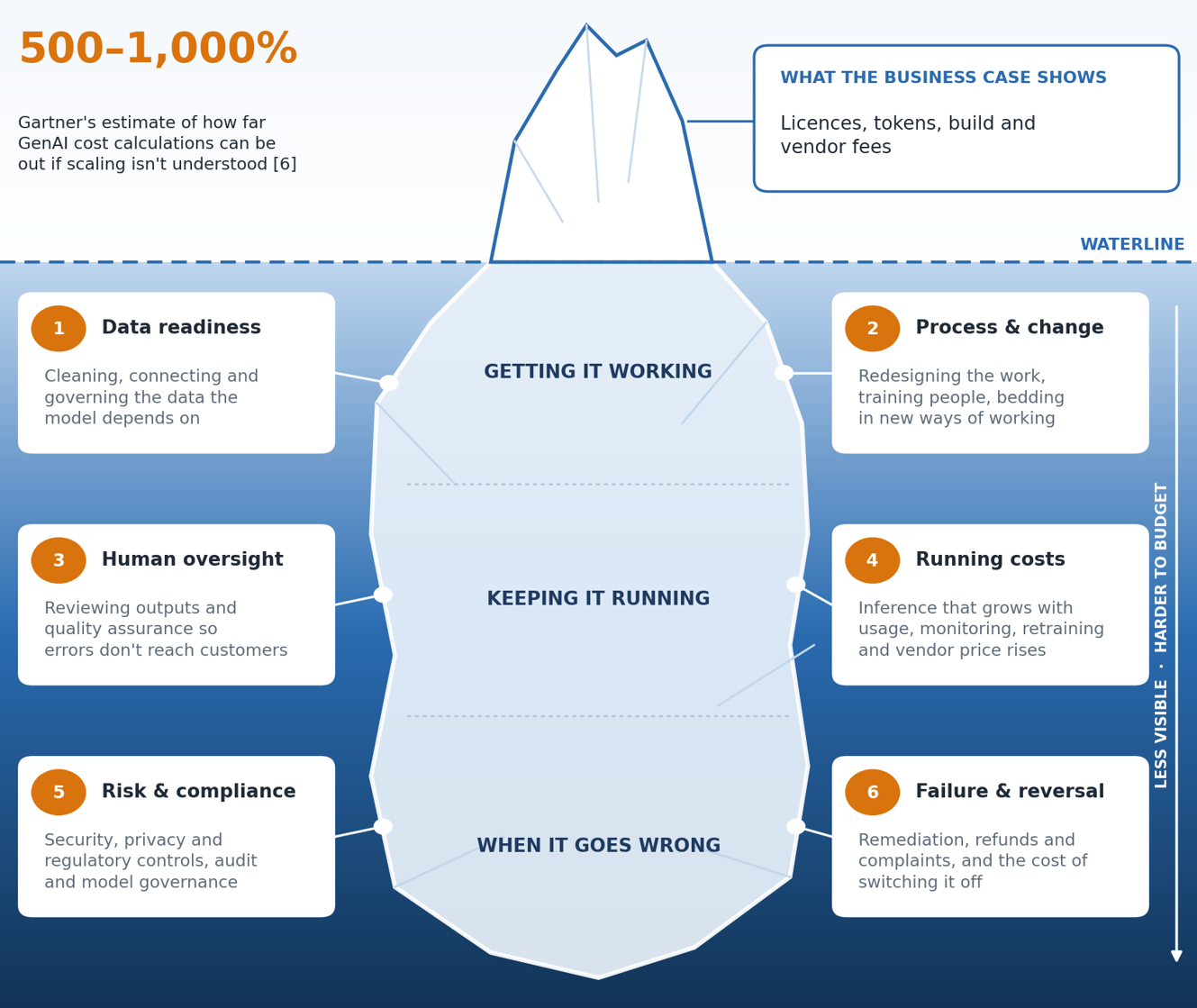
Figure 1. The true cost of an AI initiative. Most business cases capture only the tip; the larger costs sit below the waterline, and the deeper they sit, the less likely they are to be budgeted.
The analysts are blunt about the size of the gap. Gartner has warned that CIOs who do not understand how generative AI costs scale could make a 500 to 1,000 per cent error in their cost calculations [6]. It also expects at least half of generative AI projects to overrun their budgets through 2028, with inference expected to account for around 70 per cent of a model's lifetime costs [7]. And the cheap per-transaction prices many business cases assume may not last. Gartner predicts that by 2030 the cost per resolution for generative AI in customer service will exceed US$3, higher than many offshore human agents, as vendors move away from subsidised pricing [8].
Two further costs are almost never modelled: the cost of errors and the cost of reversal. We return to both in the case studies below.
3.5 Error 2: counting benefits in the wrong currency
Hours saved is the most common benefit in AI business cases and the least reliable. An hour saved only becomes value when it is redeployed to revenue-generating or customer-facing work, or when it removes a cost the organisation actually stops paying. Otherwise it is absorbed into the working day.
The Australian Government's 2024 trial of Microsoft 365 Copilot is instructive. Across around 5,700 licences in 56 agencies, participants reported saving around an hour a day on tasks such as summarising and drafting, and 69 per cent said it made them faster. Yet only about one in three used it daily, some reported it added time to their work, and the evaluation summary contained no cost or return-on-investment analysis [9]. Staff clearly valued the tool. Whether the organisation banked a return is a different question, and one the trial was not set up to answer.
3.6 Error 3: ranking initiatives by what is easiest to measure
Internal efficiency cases rise to the top of most roadmaps because they are easy to model: fewer hours, lower headcount, faster processing. The customer cost of a poor deployment sits outside the spreadsheet, so it is treated as zero.
It is not zero. Qualtrics' 2025 research across 14 countries found that 47 per cent of bad experiences lead customers to cut their spending, putting nearly US$3 trillion of global sales at risk in 2026 [10]. An AI initiative that saves internal cost but creates friction for customers can easily destroy more value than it creates. As Gartner put it when predicting that over 40 per cent of agentic AI projects will be cancelled by the end of 2027, many organisations are being "blinded to the real cost and complexity of deploying AI agents at scale" [11].
4. The twelve-month rule
We believe every AI initiative should be able to show full-cost payback within 12 months of the first dollar spent. Not eventual payback. Not payback on a benefit case that assumes perfect adoption. Payback on the whole cost, measured in cash or in customer outcomes with a cash value attached.
The rule is deliberately demanding, for four reasons.
- It matches the standard applied elsewhere. Deloitte notes that technology investments are typically expected to pay back in seven to 12 months [1]. There is no good reason to exempt AI from the test.
- It fits inside one budget cycle and one leadership tenure. The people who approve the investment are still there to see whether it worked.
- It forces scope discipline. A team that must pay back in a year cannot afford to automate everything at once. It has to pick the problem that matters most and solve it well.
- It makes the roadmap self-funding. Each increment that pays back frees cash and credibility for the next, and each one teaches the organisation something before the next dollar is committed.
Figure 2 shows the difference with the same A$12 million budget spent two ways. Roadmap A is a single two-year program that breaks even in year seven, the pattern many organisations are approving today. Roadmap B spends the same money on eight smaller initiatives, each chosen and scoped to pay back within 12 months. Roadmap B breaks even in under two years, never has more than about A$3 million at risk, and keeps compounding. Roadmap A has A$12 million at risk at the end of year two, with nothing to show for it yet.

Figure 2. Illustrative cumulative net cash for two roadmaps with the same A$12 million budget. Figures are hypothetical and for illustration only.
One caveat. Some foundations, such as a data platform or an integration layer, will never pay back on their own. They should not be funded as stand-alone AI projects. Tie them to the first initiatives that need them and require that bundle to meet the rule, or govern them openly as a strategic investment with its own board-level approval, rather than hiding their cost inside an optimistic use case.
5. Five gates for choosing what goes first
The twelve-month rule tells you whether an initiative is worth doing. It does not tell you what to do first. For that we use five gates, applied in order (Figure 3). An initiative that fails an early gate does not proceed to the later ones.
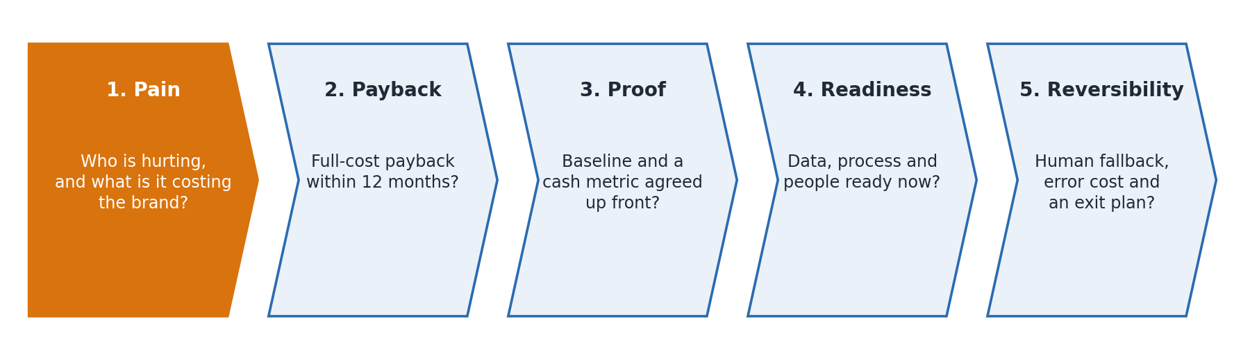
Figure 3. The five gates for selecting AI initiatives. Pain comes first.
5.4 Gate 1: Pain. Who is hurting, and what is it costing the brand?
Start with the problem, not the technology. The strongest candidates remove a pain point that customers or citizens feel directly: long waits, repeated contacts, errors, confusing processes, decisions that take weeks. These are the problems that drive complaints, churn, negative reviews, regulator attention and, over time, brand erosion.
We rank external pain ahead of internal efficiency for a simple reason. The upside of an internal efficiency initiative is capped at the cost it removes. The downside of an unresolved customer pain point is not capped at all. It compounds through lost customers, lower spend, higher service demand and reputational damage. Faced with an AI initiative that resolves billing disputes in a day instead of three weeks and another that summarises internal meeting notes, the first should win even if the second is cheaper and easier.
5.5 Gate 2: Payback. Does the full cost pay back within 12 months?
Build the business case on the full cost from Figure 1, including human review, change management and realistic running costs at scale. If the payback exceeds 12 months, do not reject the initiative outright. Re-scope it: narrow it to the highest-value segment, journey or process step, and test again.
5.6 Gate 3: Proof. Is there a baseline and a cash metric agreed up front?
Before starting, agree what will be measured, what it is today and how it converts to money: complaint volumes and remediation cost, repeat contact rates, churn, conversion, processing time linked to a cost that will actually be removed. If nobody can state the baseline, nobody will be able to prove the return.
5.7 Gate 4: Readiness. Are the data, process and people ready now?
An initiative that first requires a major data clean-up or a system replacement is not a 12-month initiative. It is a longer program with an AI component attached. Prefer problems where the data exists, the process is understood and a team is ready to own the change.
5.8 Gate 5: Reversibility. Is there a human fallback, a known error cost and an exit plan?
Ask what happens when the AI gets it wrong, who catches it, and what it costs to switch it off. Initiatives where errors are cheap to detect and fix, and where a human path remains available, are safer first moves than those where a single error lands in front of a customer, a regulator or the media.
Plotting candidate initiatives against the first two gates gives a simple portfolio view (Figure 4). Most organisations find their current roadmap is crowded into the bottom half.

Figure 4. Prioritising AI initiatives by external pain and payback period.
6. What the record shows: five case studies
The following cases are drawn from public reporting. Each illustrates at least one of the errors or gates above.
6.4 Commonwealth Bank: when efficiency ignores the customer
In July 2025 the Commonwealth Bank told 45 customer service staff their roles would be made redundant after it introduced an AI voice bot. Rather than falling, call volumes rose, and management had to offer overtime and pull team leaders onto the phones. After the Finance Sector Union took the matter to the Fair Work Commission, the bank reversed the decision in August, describing it as an "error" and saying it "did not adequately consider all relevant business considerations" [12].
The lesson: the business case measured the internal saving but not the customer demand the change would create. The reversal, the dispute and the headlines were costs no one had modelled.
6.5 Klarna: headline efficiency, then a return to quality
In February 2024, Klarna announced that its AI assistant had handled 2.3 million conversations in its first month and was doing the work of 700 customer service agents. By May 2025, the company was recruiting human agents again, with its CEO saying that investing in the quality of human support was "the way of the future" and that customers should always be able to reach a person [13].
The lesson: a benefit measured in agents replaced is not the same as a benefit measured in customers served well. The AI still handles most enquiries, but the operating model had to be rebuilt around quality, which is a cost the original case did not carry.
6.6 Octopus Energy: AI aimed at a customer pain point
UK energy supplier Octopus Energy used generative AI to draft responses to customer emails, with staff reviewing them before sending. Chief executive Greg Jackson reported in 2023 that the AI was doing the equivalent work of around 250 people, and that AI-assisted emails achieved 80 per cent customer satisfaction, compared with 65 per cent for those written by staff alone [14].
The lesson: this initiative passed the first and last gates. It targeted a high-volume, customer-facing channel and kept a human in the loop to catch errors. The efficiency gain followed from solving the customer problem, not the other way round.
6.7 Deloitte Australia: the cost of errors
In 2025, Deloitte Australia delivered a report to the Department of Employment and Workplace Relations under a contract worth just under A$440,000. The report was found to contain fabricated references and a fabricated quote attributed to a judge. Deloitte confirmed it had used a generative AI model in preparing the work and agreed to refund the final instalment of the contract [15].
The lesson: the saving from using AI was small; the cost of an unchecked error was a refund, a corrected report and headlines around the world. Human review is not overhead to be trimmed from the business case. It is part of the cost of doing AI safely.
6.8 Australian Government Copilot trial: benefits felt, not banked
As described above, the 2024 whole-of-government trial found real enthusiasm, with 86 per cent of participants wanting to keep using the tool, and self-reported time savings of around an hour a day on some tasks. Daily use was modest, managers struggled to identify AI-generated work, and there was no cost or return analysis in the published summary [9].
The lesson: productivity tools can be worth having, but they belong in the "do if capacity allows" quadrant unless the saved time is deliberately redirected to something with a measurable outcome.
7. What a self-funding roadmap looks like
Consider an illustrative mid-sized insurer (a composite, not a real organisation) with a shortlist of four AI initiatives and a A$4 million budget for the year.
|
Initiative |
Pain |
Est. full-cost payback |
Decision |
|
AI triage of claims so simple claims settle in days, not weeks |
High: claims delays are the top complaint driver |
9 months |
Do first |
|
AI-assisted replies to customer emails with staff review |
Medium: slow, inconsistent responses |
7 months |
Do first |
|
Enterprise-wide AI assistant for all staff |
Low: internal only |
No cash benefit identified |
Pilot with a named outcome, or defer |
|
Full automation of underwriting across all products |
Low to medium |
About 5 years, needs a new data platform |
Re-scope to one product line |
Illustrative composite. Figures are hypothetical.
Under a traditional approach, the underwriting program would probably have taken most of the budget because it had the largest headline saving. Under the five gates, the insurer starts with claims triage and email replies, which address what customers are actually complaining about and pay back within the year. The underwriting ambition is not abandoned. It is narrowed to one product line, where the data is ready, and funded from the returns of the first two initiatives.
8. Where to start
For executives: the first 90 days
- Inventory the current roadmap. List every AI initiative in flight or approved, with its full cost to date, its expected payback and the evidence behind it.
- Recost the top five using the full-cost model. Add human review, change, integration and running costs at realistic scale. Expect some paybacks to move out by years.
- Map initiatives to customer pain. Use complaint data, contact reasons, journey analytics and churn drivers to identify where customers are hurting most. Match initiatives to those pain points, or note that they don't match any.
- Apply the five gates and plot the portfolio. Move anything in the "stop or defer" quadrant out of the funding queue, and re-scope anything with real pain but slow payback.
- Set up benefit tracking before the next dollar is spent. Agree baselines and cash metrics for each surviving initiative, and report them monthly alongside cost.
For boards: questions to ask management
- What is the full cost of each AI initiative, including data, integration, change, human review and running costs at scale?
- What is the payback period on that full cost, and what has to be true for it to be achieved?
- Which customer or citizen pain points does our AI roadmap address, and how do we know they are the ones that matter most?
- How are benefits being measured: in cash and customer outcomes, or in hours saved and activity?
- What happens when the AI gets it wrong, and what would it cost us to switch it off?
9. Back to the steering committee
Return to that committee approving a two-year build with a seven-year payback. The problem was never ambition. It was that the roadmap asked the organisation to wait too long, spend too much before learning anything, and trust a benefit case that measured the wrong things.
The alternative is not to do less with AI. It is to sequence it so that every step pays for the next, and to point it first at the problems customers already feel. Organisations that do this will not need to justify their AI investment in year seven. They will have been banking the returns since year one.
10. About Kinetic Consulting
Kinetic Consulting is an award-winning, senior-led boutique consultancy specialising in strategy, customer experience and AI, with offices in Dubai, Abu Dhabi and Sydney. We work with organisations across financial services, telecommunications, retail, healthcare, aviation, government and other sectors to set strategy and roadmaps, redesign customer experience and operating models, and plan and deliver AI and digital transformation that pays its way. If you would like to test your AI roadmap against the twelve-month rule, we would be glad to talk.
References
[1] Deloitte (2025). AI ROI: The paradox of rising investment and elusive returns. https://www.deloitte.com/global/en/issues/ai/ai-roi-the-paradox-of-rising-investment-and-elusive-returns.html [2] IBM (2025). IBM Study: CEOs Double Down on AI While Navigating Enterprise Hurdles (press release, 6 May 2025). https://newsroom.ibm.com/2025-05-06-ibm-study-ceos-double-down-on-ai-while-navigating-enterprise-hurdles [3] McKinsey & Company (2026). The state of AI (global survey, fielded May–June 2026). https://www.mckinsey.com/capabilities/quantumblack/our-insights/the-state-of-ai [4] Boston Consulting Group (2025). AI Leaders Outpace Laggards with Double the Revenue Growth and 40% More Cost Savings (press release on The Widening AI Value Gap, 30 September 2025). https://www.bcg.com/press/30september2025-ai-leaders-outpace-laggards-revenue-growth-cost-savings [5] Virtualization Review (2025). MIT Report Finds Most AI Business Investments Fail, Reveals 'GenAI Divide' (reporting MIT Project NANDA, The GenAI Divide: State of AI in Business 2025), 19 August 2025. https://virtualizationreview.com/articles/2025/08/19/mit-report-finds-most-ai-business-investments-fail-reveals-genai-divide.aspx [6] Gartner (2024). Gartner Identifies Four Emerging Challenges to Delivering Value from AI Safely and at Scale (press release, 21 October 2024). https://www.gartner.com/en/newsroom/press-releases/2024-10-21-gartner-identifies-four-emerging-challenges-to-delivering-value-from-ai-safely-and-at-scale [7] Campus Technology (2026). Gartner: Half of Gen AI Projects Could Exceed Budget by 2028, 22 June 2026. https://campustechnology.com/articles/2026/06/22/gartner-half-of-gen-ai-projects-could-exceed-budget-by-2028.aspx [8] Gartner (2026). Gartner Predicts GenAI Cost Per Resolution for Customer Service Will Exceed Offshore Human Agent Costs by 2030 (press release, 26 January 2026). https://www.gartner.com/en/newsroom/press-releases/2026-01-26-gartner-predicts-genai-cost-per-resolution-for-customer-service-will-exceed-offshore-human-agent-costs-by-2030 [9] Digital Transformation Agency (2024). Evaluation of the whole-of-government trial of Microsoft 365 Copilot: summary of evaluation findings. https://www.digital.gov.au/sites/default/files/documents/2024-10/Copilot%20Microsoft%20365%20summary%20of%20evaluation%20findings.pdf [10] Qualtrics XM Institute (2025). $3 Trillion is at Risk due to Bad Customer Experiences in 2026, 12 November 2025. https://www.qualtrics.com/articles/customer-experience/3-trillion-risk-due-bad-customer-experiences-2026/ [11] Gartner (2025). Gartner Predicts Over 40% of Agentic AI Projects Will Be Canceled by End of 2027 (press release, 25 June 2025). https://www.gartner.com/en/newsroom/press-releases/2025-06-25-gartner-predicts-over-40-percent-of-agentic-ai-projects-will-be-canceled-by-end-of-2027 [12] ABC News (2025). Commonwealth Bank backtracks on AI job cuts, apologises for 'error' as call volumes rise, 21 August 2025. https://www.abc.net.au/news/2025-08-21/cba-backtracks-on-ai-job-cuts-as-chatbot-lifts-call-volumes/105679492 [13] CX Dive (2025). Klarna changes its AI tune and again recruits humans for customer service, May 2025. https://www.customerexperiencedive.com/news/klarna-reinvests-human-talent-customer-service-AI-chatbot/747586/ [14] TheWrap (2023). CEO: AI Outranks Humans in Customer Support Satisfaction, 9 May 2023. https://www.thewrap.com/ai-satisfies-customers-better-than-humans/ [15] Information Age (ACS) (2025). Deloitte to refund government over AI errors, 7 October 2025. https://ia.acs.org.au/article/2025/deloitte-to-refund-government-over-ai-errors.html